
How AI agents reduce fleet registration costs and capture tax savings
Multi-state fleet registration wastes both administrative hours and tax deductions when handled separately. This article shows how AI agents can automate DMV compliance while also improving IRS deduction capture, delivering a stronger combined ROI.
The real cost in multi-state fleet registration is not the fee line; it is the time spent bouncing between portals, renewal notices, and state-specific exceptions until the same vehicle record has been typed three times and still does not line up. DataGrid puts that manual load at 25-30 hours a week per fleet manager for complex multi-state work across 50 states, which reads like a vendor-specific upper bound rather than an industry average, but it matches the kind of cleanup work fleet teams know too well.[1]

Where the hours disappear
The part that eats the week is not one heroic task; it is the pile of small handoffs. Renewal tracking lives in inboxes, portal sessions, scanned PDFs, and spreadsheet reminders. Each handoff creates another place for state, VIN, plate, fee, and effective date to drift out of sync. That is why a tool that only sends reminders fixes less than it claims.
- Portal-by-portal renewal tracking
- Matching notices to the right vehicle
- Retyping the same fee and date into accounting
- Rebuilding the file when someone asks for proof
Fairway says its AI audit systems cut title and registration processing costs by more than 50% and reduce errors by 50%; FleetRabbit says AI compliance automation cuts manual compliance work by 85% and pushes audit pass rates above 90%. Those are vendor-reported figures, not independent benchmarks, but they point to the same thing: the real win is fewer touches on the same record.[2][3]
Why the record trail matters
That same record is where tax leakage starts. Under the actual-expense method described in IRS Publication 463, registration fees are part of deductible vehicle costs, but they are only as good as the traceability behind them. If the registration data is scattered across state systems and retyped into accounting later, the deduction is easy to under-claim or hard to defend.[4][5]
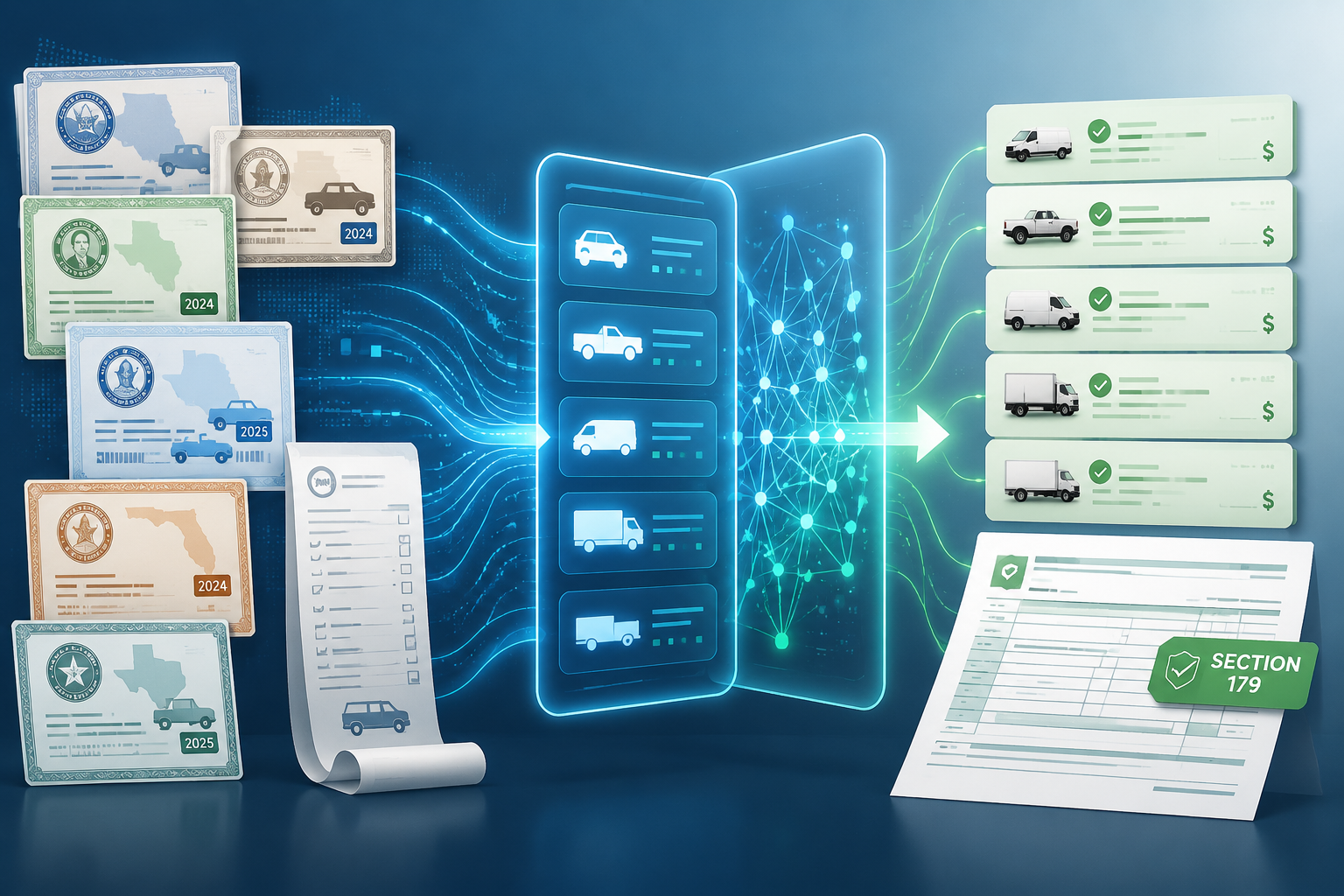
This is the bridge the market usually skips. Registration workflow data already contains the state, vehicle, fee, date, and asset link that tax review wants. If AI standardizes that once, the same record can feed renewal, audit response, and deduction capture instead of being rebuilt for each handoff. That is less glamorous than a dashboard, but it is where the money actually stays.
Section 179 matters in the same narrow way. MyFleetAI cites a 2024 deduction limit of $1,220,000 for vehicles over 6,000 lbs GVWR, but that figure is a 2024 reference point, not a 2025/2026 filing limit. The planning value is in timing and asset selection, not in treating a stale number as current law.[4]
Combined ROI
For mid-to-large fleets, the business case is stronger when compliance automation and deduction capture are treated as one workflow. Registration labor falls first, then the same cleaner data supports more complete actual-expense reporting and less back-office reconciliation. If the system cannot carry the record from DMV portal to tax file without another cleanup step, the ROI is mostly cosmetic.
That is the practical case for ai for fleet registration tax optimization: one workflow, fewer handoffs, and records that can survive a portal review, an audit request, and a tax review without being rebuilt from scratch. It is a credible use case for mid-to-large multi-state fleets, but the tax side still needs current 2025/2026 verification before anyone treats the numbers as final.
References
- How AI Agents Automate Vehicle Registration and Title Management Across States - DataGrid
- Title & Registration Software for Fleet Management Companies - Fairway
- AI Fleet Compliance Automation - FleetRabbit
- Maximize Tax Savings for Your Fleet - MyFleetAI
- Vehicle expenses that slash your business taxes today - Instead
Cited evidence
- How AI Automates Multi-State Fleet Vehicle Registration
Fleet vehicle registration is a labor-intensive multi-state compliance task that AI—through agentic document intelligence and rules engines—can automate, cutting manual portal navigation by up to 85%. This use case examines the evidence, vendor-reported outcomes, and implementation caveats for operations leaders evaluating AI in registration logistics.
- How to Set AI Screen Time Limits in Logistics Operations
Learn how to set temporal guardrails on AI autonomous decisions in logistics — including decision timeouts, escalation windows, and mandatory human review gates — to prevent machine-speed errors from compounding before oversight can intervene.
- How AI Route Planning for Road Closures Reduces Supply Chain Costs
Road closures and traffic disruptions cost supply chains $53.80 per truck-hour of delay and can cascade into $1.5M daily losses. This article examines how AI-powered dynamic rerouting recovers a significant portion of those costs, with documented logistics cost reductions of 5–20% and typical payback in 18 months, helping leaders build a quantified business case for investment.
Spotted something inaccurate or incomplete in this entry? ChainSignal reviews corrections and additional evidence before publishing an update — this is not a public comment thread.
Flag an inaccuracy / submit evidence for this entry →